The Battle of Mons 1914: The First Clash of Lions
Updated: Jul 19, 2025

Prelude: A War in the Making
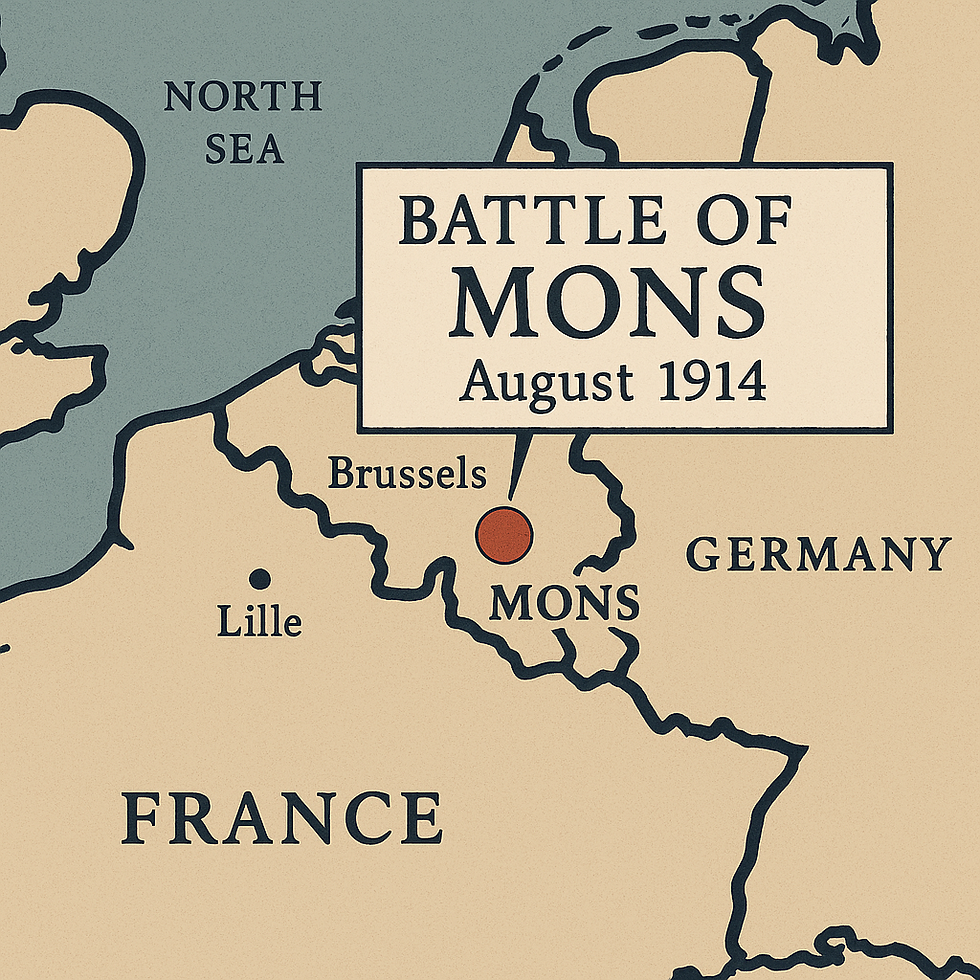
Europe stumbled into war in 1914, entangled in alliances, misjudgements, and the relentless momentum of national pride. The assassination of Archduke Franz Ferdinand in Sarajevo ignited a chain reaction of diplomatic failures, drawing the great powers into conflict. The British Expeditionary Force, a small but highly professional army, was dispatched to support the French Fifth Army and resist German forces advancing through Belgium. Mons, a mining and industrial town in the Hainaut province of Belgium, would be its first major test.
Opposing Forces: A Clash of Military Doctrines
British Forces at Mons
The BEF, under Field Marshal Sir John French, consisted of approximately 70,000 men, comprising two infantry corps, a cavalry division, and supporting artillery and engineers.
I Corps (Lieutenant General Sir Douglas Haig):
1st Division
o 1st (Guards) Brigade
o 2nd Brigade
o 3rd Brigade
2nd Division
o 4th (Guards) Brigade
o 5th Brigade
o 6th Brigade
II Corps (Lieutenant General Sir Horace Smith-Dorrien):
3rd Division (Major General Hubert Hamilton)
o 7th Brigade (including the Royal Fusiliers, defenders of Nimy Bridge)
o 8th Brigade
o 9th Brigade
5th Division (Major General Sir Charles Fergusson)
o 13th Brigade
o 14th Brigade
o 15th Brigade
Cavalry Division (Major General Edmund Allenby):
Hussars, Lancers, and Dragoons provided reconnaissance and protected the flanks.
Support Units:
Royal Field Artillery (RFA): Delivered direct fire support, often engaging over open sights.
Royal Engineers: Carried out bridge demolition and reinforced canal defences.
German Forces at Mons
Led by General Alexander von Kluck, the German First Army’s 160,000 to 180,000 troops significantly outnumbered the British forces, as part of the broader Schlieffen Plan’s aggressive push through Belgium.
III Corps (General Ewald von Lochow):
· 5th Division
· 6th Division (heavily engaged at Nimy and Obourg)
IX Corps (General Fritz von Below):
· Attacked the southern portion of the British line
IX Reserve Corps and IV Corps:
· Provided support and attempted flanking movements during the British withdrawal
Jäger and Pioneer Units:
· Specialized in engineering tasks, probing defences, and close assault operations
Artillery Regiments:
· Deployed in large formations to break enemy lines. Although numerically superior, they struggled to counter British rifle fire.

Setting the Stage: The Canal and the Crossroads
Mons stood along the Mons-Conde Canal, a vital junction in southern Belgium. On August 22, 1914, the BEF took up defensive positions along the canal to delay the German advance and protect the French Fifth Army’s flank.
Persistent rain had soaked the region. British soldiers manoeuvred into place through muddy fields and industrial ruins. They dug in around bridges and rail lines, using factory buildings and canals for cover. While generals reviewed strategy on paper maps, riflemen prepared to face a war measured not in territory, but in minutes of survival.

First Contact: August 23, 1914
At first light, German troops began their advance. British soldiers, many veterans of colonial campaigns, held firm. Their precise and rapid rifle fire, known as the “Mad Minute,” stunned the enemy. Some German units reportedly believed they were under attack from machine guns. In fact, they faced highly trained riflemen capable of delivering fifteen aimed rounds per minute.
Private John Parr, on a reconnaissance mission, became the first British soldier killed in the war. His fate foretold a brutal day. Facing forces nearly three times their size, British troops fought with discipline and skill but were slowly pushed back by the weight of German artillery and manpower.
Helmets bobbed along the canal towpath. Boots sank into the sodden earth where men had fallen. The water was thick with blood and silt, a current of devastation.

Turning Points: Nimy Bridge and the Obourg Stand
Two of the most intense engagements occurred at the Nimy Railway Bridge and the Obourg sector. At Nimy, the Royal Fusiliers faced relentless German fire as waves of infantry attempted to storm the canal.
Lieutenant Maurice Dease, despite multiple wounds, continued to direct his men and operate a machine gun under intense enemy fire. When Dease finally collapsed, Private Sidney Godley took over and manned the gun for nearly two hours, holding the position until he was severely wounded and out of ammunition. When the gun could be fired no more, Godley dismantled it and threw the parts into the canal so it would not be captured.
Private Albert Roche recalled, “Bullets sliced the air above the canal like wires pulled tight. You didn’t dare lift your head. Yet Lieutenant Dease kept shouting orders through the noise, bleeding all the while.”
Lieutenant Dease died of his wounds during the defence of Nimy Bridge, while Private Godley was captured and spent the rest of the war imprisoned at Dallgow-Döberitz in Germany. Both were later awarded the Victoria Cross for their extraordinary courage.
At Obourg, the 4th Middlesex Regiment faced repeated German assaults. Sergeant Harold Withers later wrote, “We were down to our last few cartridges, and the enemy kept coming as if they could not be stopped. We knew then that retreat was not cowardice. It was survival.”
Though severely outnumbered, British troops inflicted heavy casualties with disciplined volley fire. The illusion of a much larger defending force was sustained by their cohesion and accuracy. German units faltered under the weight of unexpected resistance.

Falling Back: The Start of the Great Retreat
By the evening of August 23, the BEF received orders to withdraw. The French Fifth Army had begun its own retreat, and continued defence risked encirclement. Rearguard units fought stubbornly to delay the German advance, their rifle barrels glowed from constant firing. Battalions disappeared into the darkness, only to reassemble miles down the road.
This marked the beginning of the Great Retreat, a punishing withdrawal of more than 200 miles toward the Marne. Exhausted and sleep-deprived, the British Army continued to fight defensive actions. Discipline held. Chaos never took root.
Outcomes
The Battle of Mons resulted in a tactical withdrawal for the British Expeditionary Force. Although heavily outnumbered, British forces held their positions for most of the day and executed a controlled retreat to avoid encirclement following the withdrawal of the French Fifth Army. Throughout this retreat, British units maintained their cohesion and discipline, an impressive feat given the exhaustion and pressure they faced. Their effectiveness in delivering rapid and accurate rifle fire left a strong impression on both allies and adversaries. Despite this professionalism, the British suffered approximately 1,600 casualties, including those killed, wounded, or reported missing.
For the German First Army, the engagement was a tactical success. They secured the battlefield and compelled the British to fall back, achieving a key operational objective. However, this came at a steep cost. The tenacity and precision of the British defence inflicted significant losses, with German casualties estimated between 5,000 and 6,000. The unexpected resistance not only disrupted their timetable but also challenged assumptions about the ease of victory over the smaller British force. What was intended to be a swift advance instead became a grim prelude to the prolonged and bloody war that followed.
Aftermath: Blood, Memory, and Myth
The Battle of Mons quickly transcended the realm of military history and entered the domain of myth and folklore. In the aftermath of the brutal engagement, strange and stirring stories began to circulate, tales of ghostly longbowmen, spectral warriors, and divine forces intervening to protect the outnumbered British soldiers. These became known collectively as the “Angels of Mons.” Some soldiers claimed to have seen luminous figures in the smoke or phantom archers releasing volleys upon the advancing Germans, evoking the spirit of Agincourt and England’s medieval past. The origin of these stories can be traced to a short story titled The Bowmen by British author Arthur Machen, published in a London newspaper shortly after the battle. Intended as fiction, Machen’s account described a heavenly host of Saint George’s longbowmen coming to the aid of the British. However, the line between fiction and reality quickly blurred. The story was reprinted, embellished, and eventually believed by many to be an eyewitness account. In a climate of fear, grief, and uncertainty, the legend took hold with remarkable speed.
Whether born of trauma, wishful thinking, or deliberate propaganda, the myth of the Angels of Mons served a clear emotional purpose. It reassured families at home that their sons were not alone on the battlefield and helped cast the British cause in a moral light. In the smoke and blood of a war that had already revealed its mechanical inhumanity, the idea of divine guardians offered a comforting and profoundly human illusion. British soldiers in unfamiliar fields, in uniforms still pressed from parade drills. Few understood that they had opened the door to a war that would consume an entire generation.
Legacy: The War Reveals Its Teeth
The Battle of Mons was the first major confrontation between the British Expeditionary Force and the German Army during the First World War. Although it ended in a tactical German victory, the battle held significant strategic and symbolic importance. Vastly outnumbered, the British force inflicted unexpectedly high casualties on the advancing Germans, showcasing the effectiveness of disciplined professional soldiers trained in rapid and accurate rifle fire. This resistance temporarily disrupted the German timetable and contributed to the eventual failure of the Schlieffen Plan, which had aimed to quickly defeat France before turning eastward.
More than a military engagement, Mons marked a psychological turning point. It shattered the illusion that the war would be swift, heroic, or limited in scope. The battle exposed the harsh reality that courage alone could not overcome modern industrial firepower, and that future conflicts would be measured not in manoeuvres or gallantry, but in endurance and attrition.
In addition to its immediate consequences, Mons carried lasting symbolic resonance. It marked the beginning of Britain’s active role in the war and helped shape the reputation of the British Army as resilient, disciplined, and tactically formidable. Though small in scale compared to later engagements, Mons signalled the beginning of a long and brutal struggle that would define the twentieth century.
In many ways, Mons was a threshold, not only in strategy but also in spirit. In the shattered factories and along the bloodied canal bridges, the new century revealed its true character. It marked its arrival not with speeches or flags, but with bullets. From that moment forward, the world would never again be silent.
March with them through mud and fire. Grab your copy of 'Gone Tomorrow' WWI novel. Step into the trenches where bullets flew, courage was tested, and legends were forged in fire.


Comments